
Self-Organizing Mesh Radio Network for Industrial Sites
Build a local digital radio network when teams move, structures change, and public networks fail.
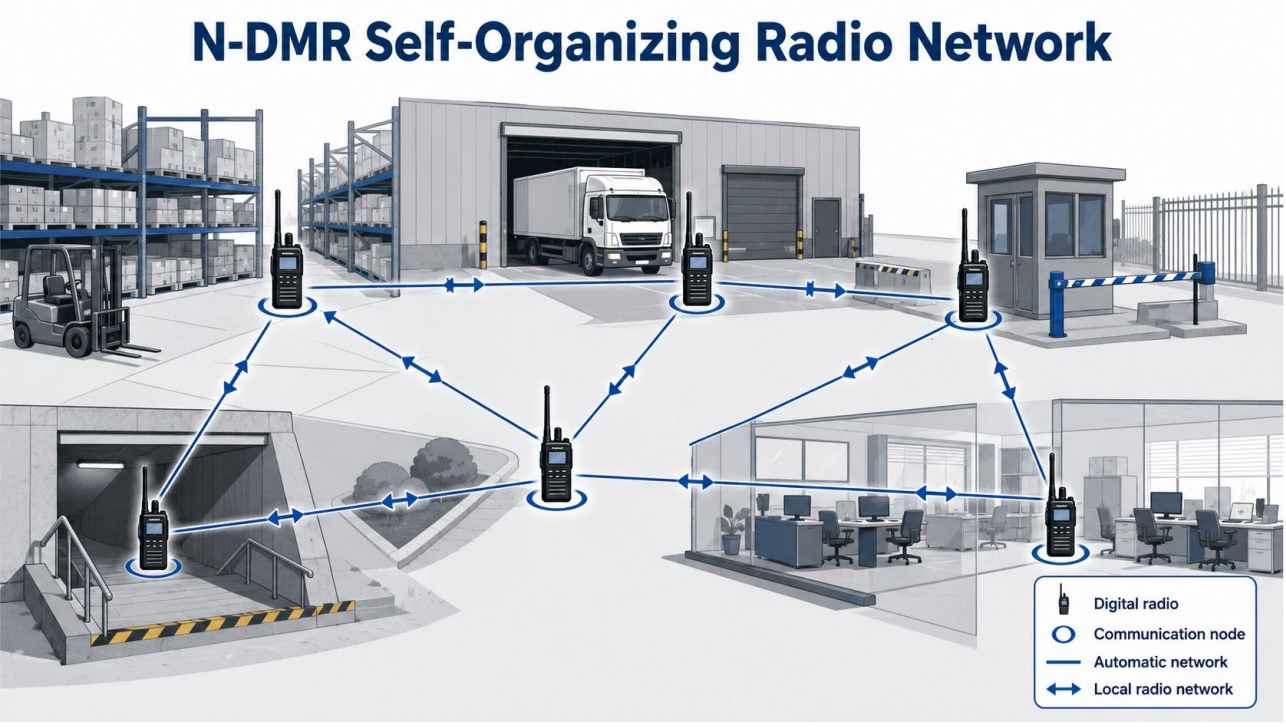
N-DMR is LINQRON's local digital wireless networking technology for digital two-way radios. After multiple digital radios are powered on, they automatically form a local communication network based on their positions and link conditions. Each radio is both a voice terminal and a network node, with no base station, SIM card or public network required.
What Is a Self-Organizing Mesh Radio Network?
On an industrial site, communication failure is rarely just "inconvenient." A forklift driver in a warehouse misses a dispatch instruction, a tunnel work face cannot reach the surface team, or an emergency team loses contact after entering a no-signal area. These are safety and efficiency problems.
These sites have one thing in common: the communication environment is dynamic. People are moving, structures are changing, public networks are sometimes available and sometimes not, and there may not be time to install a fixed repeater. What they need is not a prebuilt, fixed link, but a local wireless network that can adjust as the site changes.
LINQRON calls this local digital networking technology for industrial sites N-DMR. Its core is not making a single device stronger, but allowing multiple digital radios on site to automatically form a local communication network and work together for voice, connection, and signal forwarding.
Four Core Features of N-DMR
This self-organizing networking technology can be summarized in four points. Once you understand these four points, you understand the difference between N-DMR and ordinary point-to-point radio communication.
- Automatic networking. After the radios are powered on, they can quickly form a network based on the wireless connection conditions on site. The devices build the network themselves instead of relying completely on pre-installed fixed facilities.
- Decentralization. The network does not place all communication pressure on one fixed central point. Every digital radio participates. When one radio moves, powers off, or leaves the site, local communication may still continue as long as usable nodes and paths remain.
- Communication as a node. Each digital radio can talk and can also serve as a forwarding node, passing the signal to farther devices. This is the basis for maintaining communication in complex structures.
- Dynamic topology. When people move, devices are added or removed, or the site structure changes, the connection relationship between radios reorganizes according to actual conditions. Chain, tree, mesh, and other flexible topologies are supported.
Why Do Industrial Sites Need Self-Organizing Networking?
Ordinary radio communication is more like a direct conversation between two devices. When the distance is short and the site is open, it is usually enough. But industrial sites are rarely open environments.
Real sites include metal racks, concrete walls, underground floors, tunnel curves, steel structures, cold storage partitions, heavy machinery, moving personnel, and constantly changing construction layouts. All these factors can make an originally fixed communication path unstable.
The meaning of self-organizing networking is that communication is not tied to one path. The site is no longer limited to the question of whether two radios can connect directly. Instead, multiple radios form a local network that can adjust with the site.
N-DMR vs. Traditional Repeater System
This does not mean traditional repeaters are outdated. When a site is long-term, fixed, structurally stable, and has clear coverage requirements, a fixed repeater is still a mature solution. When the site is temporary, people move frequently, the structure is complex, or fixed equipment is hard to install, self-organizing networking is more flexible.
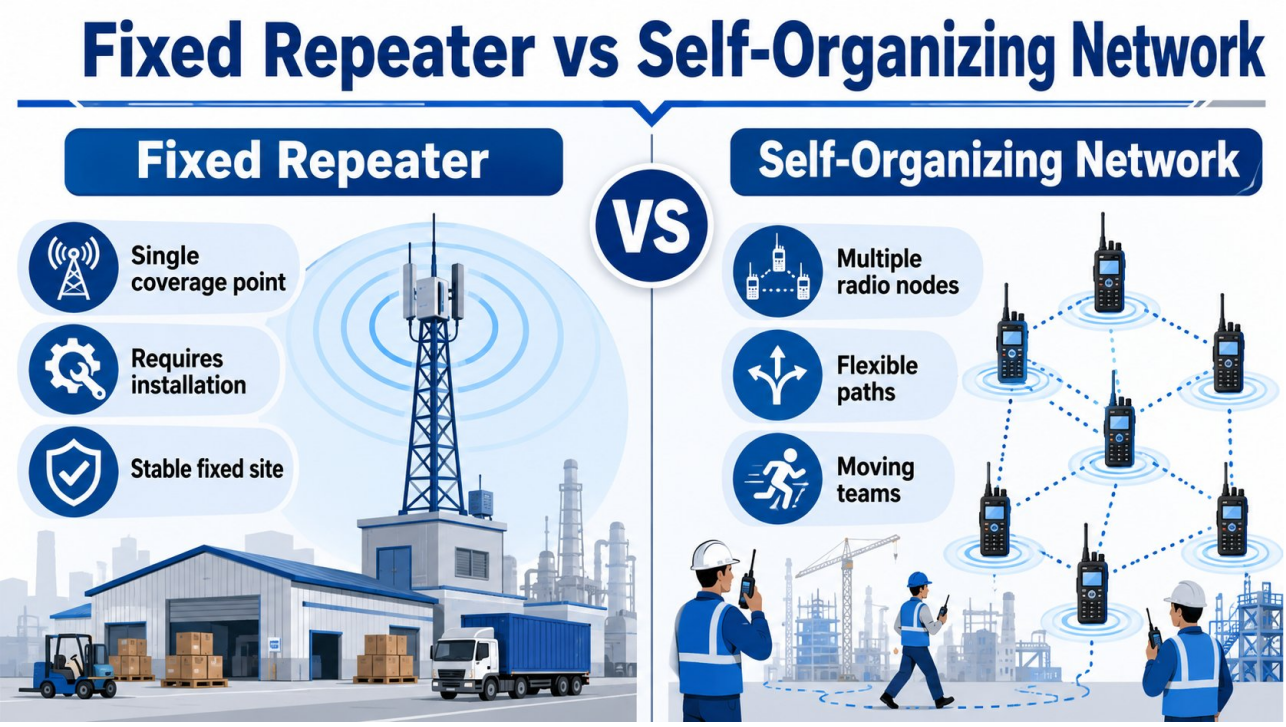
Fixed repeater relies on a single coverage point with installation requirements. Self-organizing network uses multiple radio nodes with flexible paths for moving teams.
| Comparison | Traditional Repeater | N-DMR Self-Organizing Network |
|---|---|---|
| Network structure | Relies on a fixed repeater point | Multiple digital radios jointly form a local network |
| Deployment method | Requires site selection, installation, power and antenna | More suitable for temporary, mobile or complex sites |
| Flexibility | May need adjustment after structural changes | Network relationships change as devices move |
| Single-point risk | Key repeater failure affects coverage | Does not fully depend on one fixed device |
| Best for | Long-term fixed buildings, stable coverage | Tunnels, warehouses, construction sites, emergency response |
N-DMR vs. PoC Radio
They solve different problems. N-DMR solves "how to communicate inside one site." PoC relies on 4G/5G and is suitable for cross-city teams, multiple sites, fleets, and visual dispatch from the backend. They are not substitutes. In large projects, they can be used together.
| Comparison | N-DMR Digital Radio | PoC Radio |
|---|---|---|
| Network dependency | Local wireless network | 4G / 5G public network |
| Suitable range | Communication inside a single site | Cross-region, cross-city, fleet dispatch |
| Typical scenarios | Warehouses, tunnels, construction sites | Logistics fleets, multiple sites, cross-city teams |
| Data card required | Usually not needed | Usually needs a SIM card |
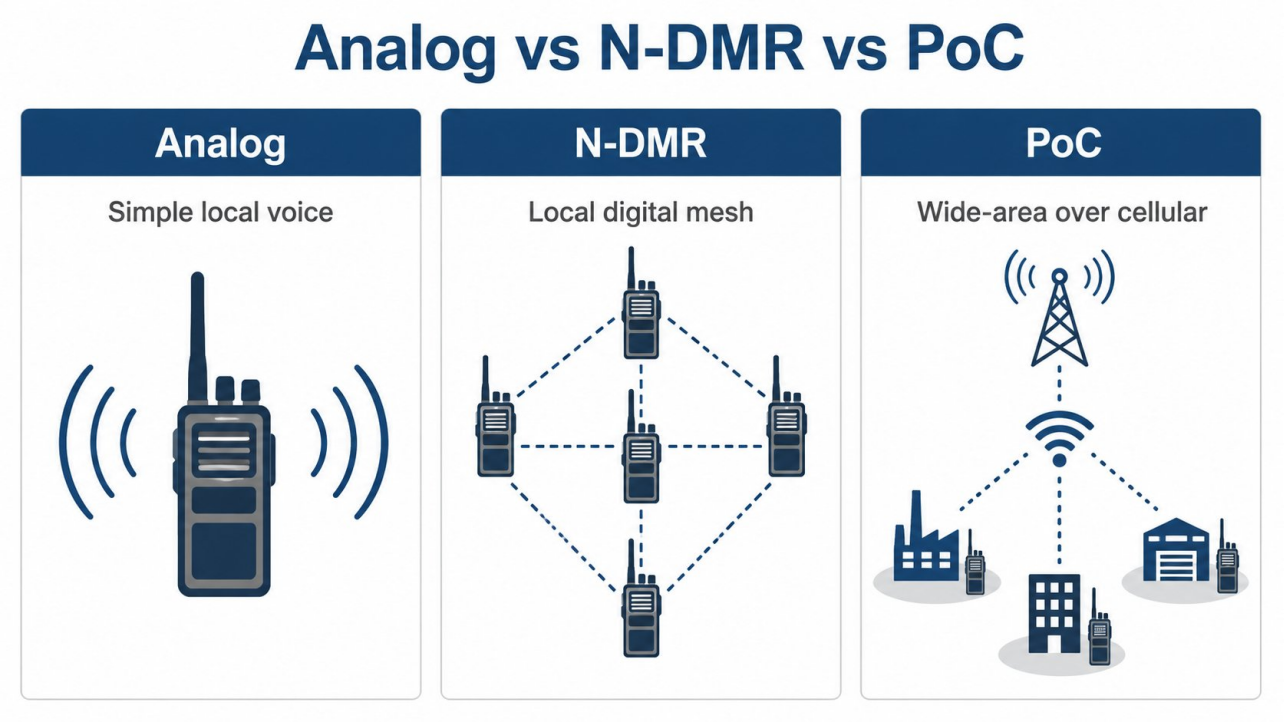
Three radio system types: Analog for simple local voice, N-DMR for local digital mesh networking, PoC for wide-area communication over cellular.
N-DMR vs. Analog Radios
Analog radios are simple, low-cost, and easy to use. They still have value in simple-structure scenarios such as small warehouses, hotels, property management, and security patrols. N-DMR digital radios are more suitable for projects that need clearer voice, local wireless networking, stronger device management, and less dependence on fixed repeaters or public networks in complex environments.
This is also the meaning of digital-analog dual-mode devices such as B17: if a site still keeps many analog radios, B17 can support a smooth transition instead of replacing everything at once.
| Comparison | Analog Radio | N-DMR Digital Radio |
|---|---|---|
| Voice quality | Basic | Clearer voice and better interference resistance |
| Local networking | Not supported | Supports automatic networking and multi-hop |
| Management | Basic | Groups, private calls, encryption, etc. |
| Best for | Simple, structurally stable small sites | Complex, mobile, underground, weak-network sites |
Which Scenarios Are Suitable?
When a site has the following characteristics, N-DMR is usually a more suitable direction:
- Weak or unstable public network
- Frequently moving personnel or temporary project conditions
- Complex structures, underground or tunnel areas
- Inconvenient fixed repeater installation
- Need for quick local communication
- Desire to reduce dependence on one central device
Typical applications include large warehouses, cold-chain storage, basements and underground parking, tunnel projects, mining areas, construction sites, industrial parks, emergency repair, and field inspection.
Corresponding LINQRON Products: B15 / B15P
N-DMR self-organizing networking is a core capability of B15 and B15P. They support local digital communication, built-in relay, multi-level forwarding, and 30-level relay without relying on SIM cards, data cards, or public-network platforms.
B15 is more suitable for basic local self-organizing communication. B15P adds a screen and keypad, making it suitable for projects that need channel information, group switching, private/group operations, or system settings.
What to Confirm Before Deployment
Before planning an N-DMR local wireless network, confirm the following to avoid choosing a model without accounting for the real communication environment:
- Use scenario and site area
- Floor structure and whether underground space is included
- Main obstacle types (metal racks, concrete, rock)
- Number of users and expected device quantity
- Whether personnel move frequently
- Whether compatibility with old analog radios is required
- Whether explosion-proof certification is required
- Whether backend dispatch or positioning is required
- Country/region of use and local frequency and certification requirements